Hospitality Management: An Important Driver of Workplace Well-Being?

In a luxury hotel, concierges do more than simply respond to requests. Their role is to anticipate guests’ needs and desires. This level of attention, long associated with luxury hospitality, is now making its way into the workplace. This is the principle behind hospitality management.
From hotels to offices and event venues, this approach takes different forms but always pursues the same objective: to deliver a seamless and attentive experience. Here is everything you need to know about hospitality management, the role of the hospitality manager, and the steps involved in implementing it within a company. At John Paul, a subsidiary of the Accor Group, providing our Members with the best possible welcome is a top priority.
What Is Hospitality Management?
Hospitality management involves organising the welcome and overall experience of individuals, whether they are customers, visitors or employees. This includes several stages, from coordinating teams to managing the services available to them. In a hotel, the aim is to satisfy guests while ensuring the smooth running of the establishment. In a corporate environment, the focus shifts towards workplace well-being and the quality of everyday services.
Tourism plays a significant role in the French economy. In 2023, it directly accounted for 3.8% of GDP (source: Atout France, based on INSEE data). At the beginning of that same year, France had nearly 11,900 classified hotels, representing approximately 529,000 rooms (source: L'Hôtellerie Restauration, based on Atout France data). Today, the principles of hospitality extend far beyond the hotel industry, with companies adopting them to provide a better welcome for visitors and employees alike.
Where Does the Term Come From? From Luxury Hotels to All Industries
The term combines the Latin word hospes, meaning "host" or "guest", with the English word "management". The practice developed notably through the grand hotels of the 19th century. In luxury hospitality, it is based on a simple principle: paying attention to every detail and providing personalised service, even before a request has been made.
This expertise is now expanding into other industries. With the rise of hybrid working, companies are looking to make their offices more welcoming and stand out to potential candidates. Some are therefore turning to professionals trained in leading Parisian hotels to rethink their reception services.
Hospitality Management or Hotel Management: What Is the Difference?
The two concepts are closely related, but they do not mean the same thing. Hotel management refers to the running of a hotel establishment, including administration, accounting, accommodation, food and beverage services, and marketing. It is therefore one branch of hospitality management.
Hospitality management covers a much broader field. It applies not only to hotels but also to restaurants, tourism, events and corporate reception services. It can even be found in industries such as sports and real estate. The term "hotel management" therefore does not fully reflect its scope.
Hotels, Corporate Environments and Events: The Three Main Areas of Hospitality
Hospitality management operates across three major sectors: hotels and tourism, corporate environments, and events. Objectives and responsibilities vary, but they all share one common goal: providing a welcome that meets individual expectations. Here are the main differences:
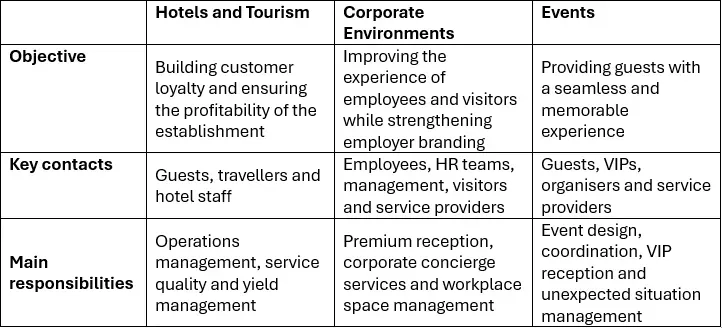
In Hotels and Tourism: Managing an Establishment
This is the sector in which hospitality management first developed. The manager is responsible for ensuring the smooth running of the establishment, supervising teams and monitoring performance. They notably rely on revenue management and yield management to adjust prices according to demand.
This sector remains particularly important today. Domestic tourism expenditure in France could reach €222 billion in 2025, according to an estimate by Atout France. In Paris, standards are especially high, with 46% of hotel rooms in the Île-de-France region classified as four- or five-star establishments (source: L'Hôtellerie Restauration, based on Atout France data).
In Corporate Environments: Bringing Luxury Hospitality Standards into the Workplace
In a corporate setting, hospitality helps transform the workplace into a more welcoming and enjoyable environment. In practical terms, this can include:
- Premium reception: a welcoming lobby designed to reflect the company's identity, professionally trained reception staff and a seamless visitor journey.
- Corporate concierge services: dry cleaning, reservations and everyday administrative assistance, helping employees save time.
- Workplace activities and events: meetings, workshops and social gatherings that encourage interaction and create stronger connections.
- Phygital reception: combining a human presence with digital tools (physical and digital) to provide a consistent experience from beginning to end.
This is where a premium concierge service becomes particularly valuable, as it demonstrates the attention given to each employee.
In Events: Tailor-Made VIP Hospitality
Whether at a conference, a sporting event or a private reception, every detail matters when it comes to welcoming guests under the best possible conditions. The hospitality manager organises VIP reception, coordinates registrations and transport, and manages communication with hotels.
The same level of attention is essential when designing corporate experiences and events for clients and business partners.
John Paul’s Event Expertise Presentation
Why Is Hospitality Management Becoming a Key Priority for Businesses?
With the rise of hybrid working, employees no longer automatically come into the office. The welcome they receive, the spaces they work in and the services available to them can all encourage employees to return, while also helping attract future candidates.
Hospitality management is therefore becoming a genuine strategy for improving employees' everyday experience and strengthening a company's attractiveness.
Employee Experience and Quality of Life and Working Conditions
The concept of Quality of Life and Working Conditions (QVCT) has a relatively recent history. France's National Interprofessional Agreement (ANI) of June 2013 established that employees' perception of quality of working life depends on their working conditions and their ability to express themselves and have an influence on their work.
According to ANACT (the French National Agency for the Improvement of Working Conditions), the objective is to enable everyone to carry out their work under good conditions. This means considering not only employees' health but also the organisation and content of their work.
Several initiatives can contribute to this, such as a welcoming reception, practical services and solutions that save time in everyday life. However, these measures cannot replace a comprehensive QVCT policy. Improving working conditions in the long term still requires a focus on organisational structures and management practices.
Employer Branding and Talent Retention
Candidates visiting your offices can quickly form an impression of your company culture. A warm welcome, visible services and an available team can say much more than a brochure. This is a significant asset for your employer brand.
Talent retention follows the same logic. Employees who feel valued have more reasons to remain committed to a company over the long term. Employee benefits designed to retain your workforce are part of this approach, provided they are based on the actual needs of your teams.
The Role of the Hospitality Manager: Responsibilities and Skills
The hospitality manager is the professional primarily responsible for reception and hospitality services. They ensure that everyone's needs and expectations are met, from arrival to departure. Depending on the organisation, their responsibilities may cover a hotel, a corporate site, an event venue or a range of services.
Day-to-Day Responsibilities (Reception, Services, Activities and Coordination)
Their working days combine an overview of operations with a hands-on presence in the field:
- Reception: establishing service standards, training and supervising reception staff.
- Services: selecting and monitoring service providers and adapting the offering to meet needs.
- Activities: organising key events and initiatives that bring spaces to life.
- Coordination: ensuring effective collaboration between internal teams, partners and management.
- Performance management: monitoring satisfaction, service usage and budgets.
Key Skills: Customer Service, Cross-Functional Management and Financial Management
Three key skills stand out:
- A strong sense of service: anticipating needs, remaining available without being intrusive, and offering solutions rather than simply explaining why something cannot be done.
- Cross-functional management: coordinating internal teams and service providers, negotiating and managing conflicts.
- Financial management: controlling budgets, negotiating with suppliers and measuring the return on investment of the services implemented.
Other essential qualities include attention to detail, strong interpersonal skills and the ability to remain calm under pressure.
How to Implement a Hospitality Strategy Within a Company
Defining hospitality management is not enough: it requires an action plan. Here is a four-step approach that can be applied to organisations of any size. This is where everything comes together.
Step 1: Assess the Needs of Employees and Visitorss
Start by listening. Ask your teams about the everyday challenges they face, such as commuting, administrative procedures, reception services and organisation.
Also observe the visitor journey, from entering the building to reaching the meeting room. This initial assessment will help you avoid implementing services that nobody will actually use.
Step 2: Choose the Right Services (Reception, Concierge, Events and Activities)
Based on the needs identified, select the services that are most relevant.
A high-traffic site will prioritise reception services. A company whose employees are short on time may invest in corporate concierge services. An organisation looking to strengthen team cohesion will focus on activities and events, for example by organising a corporate seminar that leaves a lasting impression.
It is better to offer a small number of well-executed services than an extensive but poorly managed catalogue.
Step 3: Manage Services In-House or Work with an External Provider
You can develop your offering internally or rely on a specialist provider.
Managing services in-house offers complete control but requires time, expertise and a solid organisational structure. An external provider brings proven expertise, trained teams and the ability to adapt quickly.
In both cases, continuity is essential. Our hands-on experience, with a 24/7 service available to VIP clients, confirms that a service only truly exists if it is there when people need it.
Step 4: Measure Performance (Service Usage, Satisfaction and Retention Rates)
Without measurement, hospitality remains just an intention. Establish a few simple performance indicators from the outset:
- Service usage rate: which services are actually being used, and by whom?
- Satisfaction: short surveys, direct feedback and changes over time.
- Retention: the observed impact on employee engagement and staff retention.
These insights allow you to adjust your offering and justify the investment to your management team.
John Paul: Hospitality at the Service of Your Clients and Employees
A subsidiary of Accor, John Paul brings the art of hospitality to businesses, brands and their clients.
Our premium concierge service supports employees in their everyday lives, with 24/7 availability and service standards inherited from the world of luxury. It caters to both corporate teams and the most demanding clients.
We also design services and initiatives that extend the overall experience. Our events team creates memorable experiences, while our expertise in relationship marketing strengthens connections with your clients, particularly through carefully designed loyalty programmes.
John Paul teams support you in defining the services best suited to your organisation, from the initial planning stage through to day-to-day management.
Studying Hospitality Management: Courses and Career Opportunities
Hospitality and management schools offer several different educational pathways, and hospitality management programmes are attracting an increasing number of students. This section provides a general overview: the right course will depend on your career goals.
BTS, Bachelor's Degree and MSc: Different Levels of Study
- BTS (Brevet de Technicien Supérieur, equivalent to a two-year higher education qualification): a highly vocational first step, providing students with the foundations of reception and customer service.
- Bachelor's degree (three years of higher education): develops knowledge of management, marketing and team leadership, often including work experience in a professional environment.
- MSc (Master of Science, five years of higher education): prepares students for management and leadership positions, with a strategic and international focus.
Several institutions offer these qualifications, including FERRANDI Paris (BTS, Bachelor's degree and MSc programmes), Paris School of Business (MSc in Hospitality and Tourism Management) and INSEEC (specialisations in Luxury & Wine and International Business).
Work-study programmes are available at several levels, allowing students to gain practical professional experience early in their careers.
How Much Does a Hospitality Manager Earn?
There is no sufficiently reliable publicly available average salary figure covering all hospitality managers. Salary levels depend notably on the industry, company size, professional experience and language skills.
As a benchmark for a related profession, Michael Page estimates that a reception host earns approximately €25,000 gross per year at the beginning of their career, rising to €31,000 after five years of experience (source: Michael Page 2026 Salary Study for Reception Hosts).
Key Takeaways: How Hospitality Shapes the Employee Experience
Hospitality management is no longer limited to hotels. In the corporate world, it connects employee well-being, brand image and business performance.
To make it work, focus on the key drivers: listening to your teams, choosing useful services, working with experienced professionals and measuring results.
John Paul teams support you at every stage. To explore this further, discover how to build loyalty programmes that extend this approach to customer care.
FAQ: Your Questions About Hospitality Management
What Is a Hospitality Manager?
A hospitality manager is a professional responsible for managing the welcome and overall experience of clients, visitors or employees. They coordinate teams, services and external providers to ensure consistently high standards of service.
What Does Hospitality Mean?
Hospitality refers to the art of welcoming and taking care of another person. Originating in the hotel industry, it now extends to corporate environments, events and many other types of spaces.
What Is the French Translation of "Hospitality Management"?
The term can be translated into French as "gestion de l'hospitalité" or "management de l'accueil et de l'expérience". The term "management hôtelier" is closely related but is limited to the hotel industry.
What Is the Average Salary of a Hotel Manager?
Salary depends on the establishment, location and level of professional experience. We do not have a sufficiently reliable figure for this specific role. For a benchmark relating to reception services, please refer to the Michael Page salary study mentioned above.